BLOG DEVELOPPEMENT
Articles Tech
Actualites, conseils et retours d'experience sur le developpement web et mobile.
Does the European Accessibility Act apply to you? The three-question test
The obligation has applied since 28 June 2025 and most businesses still do not know whether it targets them. The threshold is precise, it fits in three questions, and getting it wrong is not a theoretical risk.
How to choose a web agency: the checks that actually predict success
Two thirds of digital projects fail at least partly, and the first cause identified is the choice of provider. Here is what to verify before signing, and the questions that separate a partner from a supplier.
What a website really costs: the drivers nobody puts in the quote
Asking what a website costs is like asking what a building costs. The useful question is what makes the number move, and which recurring costs are missing from the quote you are holding.
When to redesign your website: 6 signals worth measuring
Most redesigns start with a feeling that the site looks dated. That is the worst reason to spend the money. Here are six signals you can measure today, and what each one actually costs you.
Per-Seat SaaS vs Self-Hosted Postgres: The Arithmetic Nobody Runs Honestly

Airtable Business at 15 seats costs $8,100 a year. A private European server costs €180 to €540, whatever the headcount. Here is the honest arithmetic, what the subscription also paid for, and when the migration is a bad idea.
Kickbacks, two months on: 121,597 dollars counted and a signature check that checks nothing
Kickbacks now shows 121,597 dollars on its developer earnings counter, and the most favourable estimate puts a typical month at about 40. Then a security review found an extension that patches files, updates itself every 90 seconds and verifies signatures against an empty key. Then a security review found an extension that patches files, updates itself every 90 seconds and verifies signatures against an empty key.
OpenAI's Astra and Lean 4: how we know the proofs hold, and where that stops
On 1 August 2026, OpenAI published Lean 4 certificates for ten long-open math problems. Machine checking settles one question and leaves a harder one open.
Claude Opus 5: the best Opus yet, same price as Opus 4.8, approaching Fable 5, put to the test
On July 24, 2026, Anthropic shipped Claude Opus 5 at the exact same price as Opus 4.8 ($5 / $25 per million tokens) while getting close to Fable 5. New effort dial, strong company-reported benchmarks worth verifying, and our honest analysis of what these numbers are really worth.
Grok 4.5 is out: xAI's fast, cheap frontier model that lands at #8 on intelligence
On July 8, 2026, xAI shipped Grok 4.5, its frontier model for coding and agentic work, at an aggressive price: $2/$6 per million tokens. We pulled the docs and the independent Artificial Analysis leaderboard to separate the hype from the data. The honest picture: Grok 4.5 is fast and cheap and genuinely capable, but on independent intelligence it ranks #8 (Index 54), behind Claude and GPT, and its context window quietly dropped to 500k. Here is where it really sits in the AI race.
Meta's Muse Image: an AI that generates, edits, codes, and second-guesses itself, and a privacy storm
On July 7, 2026, Meta Superintelligence Labs shipped Muse Image, a new flagship model that does not just make pictures: it reasons before it draws, writes code, searches the web, and reviews its own output before showing it to you. It debuted at #2 on the blind Arena leaderboards, behind only OpenAI's GPT Image 2. But the launch is shadowed by a privacy backlash over letting people generate AI content from other users' Instagram photos, on an opt-out basis. Here is what is real.
Anthropic just switched Claude Fable 5 back on: inside the 19-day suspension and the redeployment
For 19 days, the most capable widely released AI model on the planet was switched off by a US export-control directive. On July 1, 2026, Anthropic redeployed Claude Fable 5 (and Mythos 5) after a jailbreak, discovered by Amazon researchers, let it surface software vulnerabilities. We pulled the official announcement to lay out the exact timeline, why it was pulled, and the safeguards, a 99%-plus classifier that reroutes to Opus 4.8 and a government AI standards body (CAISI) calling them extraordinarily strong, that got it back online. Here is what actually happened.
Claude Sonnet 5 is here: Anthropic just put near-Opus power at a Sonnet price
On June 30, 2026, Anthropic shipped Claude Sonnet 5, 'the most agentic Sonnet model yet', generally available the same day across all plans and in Claude Code. We went to the official system card and pricing docs to separate the verified facts from the marketing: a 1M-token context, $3/$15 pricing ($2/$10 until August 31), and company-reported benchmarks that land Sonnet 5 within touching distance of the far pricier Opus 4.8. Here is the honest breakdown of whether it is the new default model for builders.
Figma Motion: can one new feature save a stock that crashed almost 90%?
On June 24, 2026, Figma shipped Motion, a native timeline animation mode that drops the company straight into After Effects territory. It lands against a brutal backdrop: the stock is down roughly 87% from its post-IPO peak. So we went to the primary sources, the Figma launch post, the SEC filings, the investor releases, and did the math. The twist nobody mentions: the business is accelerating while the share price collapsed. Here is the honest breakdown of whether Motion can re-rate Figma.
Seedance 2.5: ByteDance just broke the 30-second barrier for AI video, and the receipts are wild
On June 23, 2026, ByteDance announced Seedance 2.5: single-pass, 30-second native video from one continuous generation, accepting up to 50 reference inputs. We pulled the primary sources to separate the verified facts from the hype, mapped the full Seedance lineage, and put the only independently verified numbers on the table: the prior Seedance 2.0 already sits at #1 on the Artificial Analysis Video Arena, ahead of Google Veo 3.1. Here is the honest data creators and businesses can actually build on.
GLM-5.2: the open-weights LLM that just became the world's best, at one-sixth the cost
In mid-June 2026, Zhipu AI shipped GLM-5.2: an MIT-licensed, open-weights model with a real 1M-token context that independent benchmarker Artificial Analysis ranks the number-one open model on Earth, fourth overall, at roughly one-sixth the price of GPT-5.5. We break down the benchmarks, the pricing, the self-hosting reality and the governance catch, and what it actually means for businesses building with AI.
Midjourney says its body scanner could cut deaths 30%: what's real, what's hype
On June 17, 2026, the AI image company Midjourney unveiled a whole-body ultrasound scanner and claimed preventive imaging could 'avoid 30 percent of all deaths and 50 percent of all healthcare costs.' We checked every claim against SEC filings, peer-reviewed physics and the FDA. The partnership is real and already paying. The headline numbers are not.
SpaceX buys Cursor for $60 billion: when your code editor joins an empire
On June 16, 2026, four days after its record IPO, SpaceX signed a deal to acquire Cursor, the hottest AI code editor, for $60 billion in stock. How an IDE that went from $100M to $4B in revenue in eighteen months ends up absorbed into Elon Musk's empire, alongside xAI, Grok, X and the Colossus supercomputer. Data, timeline, and what it changes for everyone who codes on it.
When the state can switch off your AI: Washington suspends Fable 5 and Mythos 5
On June 12, 2026, at 5:21pm ET, the US government ordered Anthropic to suspend all access to Fable 5 and Mythos 5, and to comply, Anthropic had to abruptly disable both models for every customer on Earth, three days after launching them. An export-control directive, a disputed 'jailbreak', and a hard lesson for any business that runs on a model it does not own. What happened, and what to do about it.
Kickbacks.ai: ads in the Claude Code spinner, anatomy of a land grab with no lease
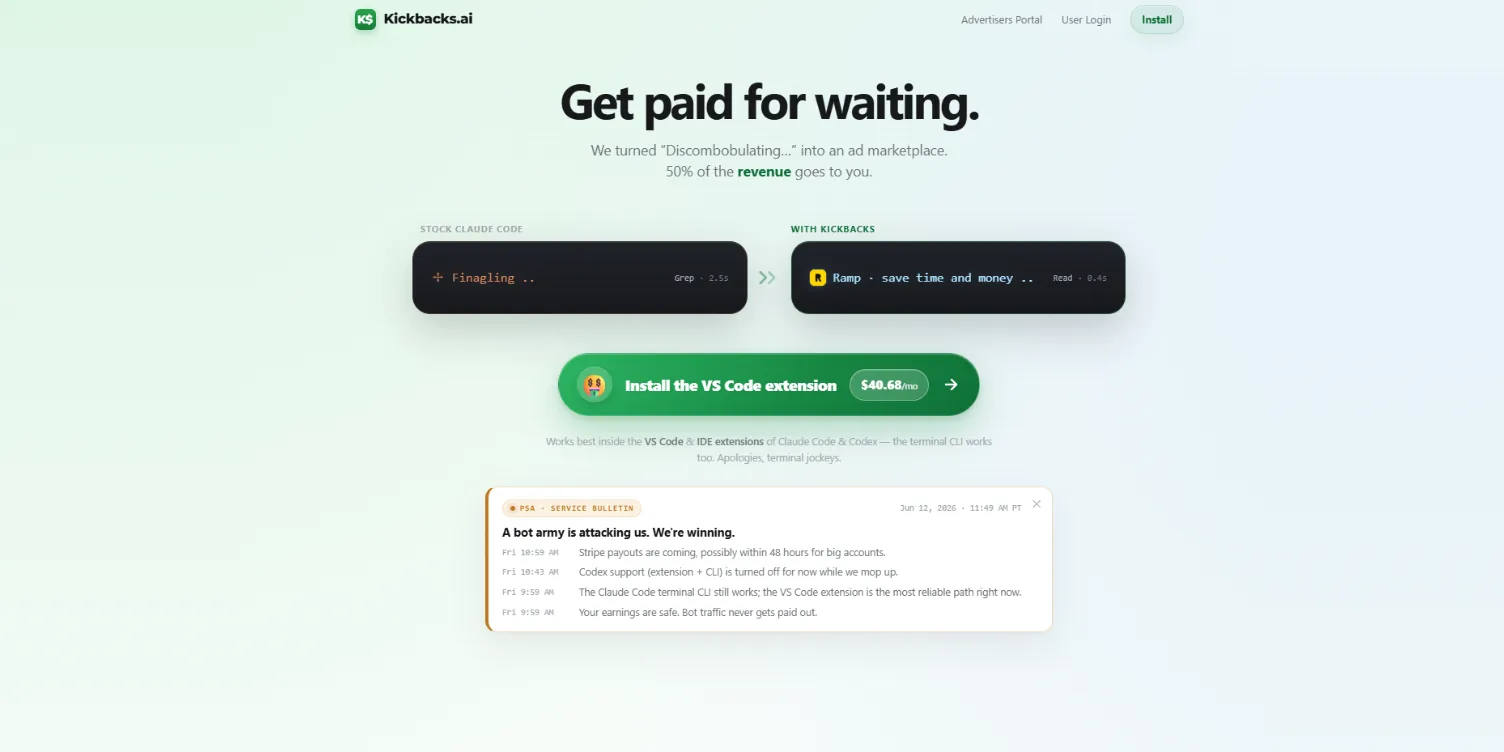
On June 11, 2026, Andrew McCalip launched Kickbacks: an extension that replaces the Claude Code spinner with an auctioned ad and pays the developer 50% of the revenue. 5.5 million views in 24 hours, two competitors within 48 hours, and one uncomfortable question: what happens when you build a business on someone else's product? We read the extension's code. Full breakdown.
Autonomous AI agents for SMBs in 2026: realistic use cases, costs and limits
AI agents are no longer reserved for large enterprises. Here is how small and midsize businesses can automate customer support, outbound prospecting and back-office work with autonomous agents, including what they cost and where they fail.
ChatGPT for business: the practical guide for 2026
How to use ChatGPT and Claude effectively and responsibly in your business: five concrete use cases, the exact prompts we use, the real limits, and a rollout plan that works.
Next.js vs WordPress in 2026: which one for your web project?
Next.js or WordPress? This technical and strategic comparison helps you pick the right technology for your web project based on your goals, your budget, and your performance requirements.
Anthropic's Economic Policy Framework: the three-tier plan for AI and jobs, explained
In June 2026, Anthropic published its Economic Policy Framework: a three-tier plan, indexed to the unemployment rate, for responding to AI's impact on work. Universal capital accounts, modernized unemployment insurance, candidate redistribution mechanisms, and four concrete actions the document assigns to companies. A breakdown, and what it means for your business.
Claude Fable 5 for business: pricing, API, use cases and adoption strategy
Anthropic launches Claude Fable 5, the first Mythos-class model in general availability. API pricing, included at no extra cost in subscriptions until June 22, Opus 4.8 fallback, 30-day retention: the practical guide to deciding what to do with it in your company.
Claude Fable 5 and Mythos 5: the complete guide to Anthropic's launch
On June 9, 2026, Anthropic launched Claude Fable 5, the first Mythos-class model available to the general public, and Claude Mythos 5, its safeguards-lifted sibling reserved for cyberdefenders. The Mythos class, benchmarks, safeguards, Project Glasswing, scientific breakthroughs: everything in this announcement, explained.
Next.js 15 App Router for e-commerce: production lessons from 2026
Twelve months of running Next.js 15 App Router in e-commerce production: what works, what breaks, and the migration patterns that survived contact with reality.